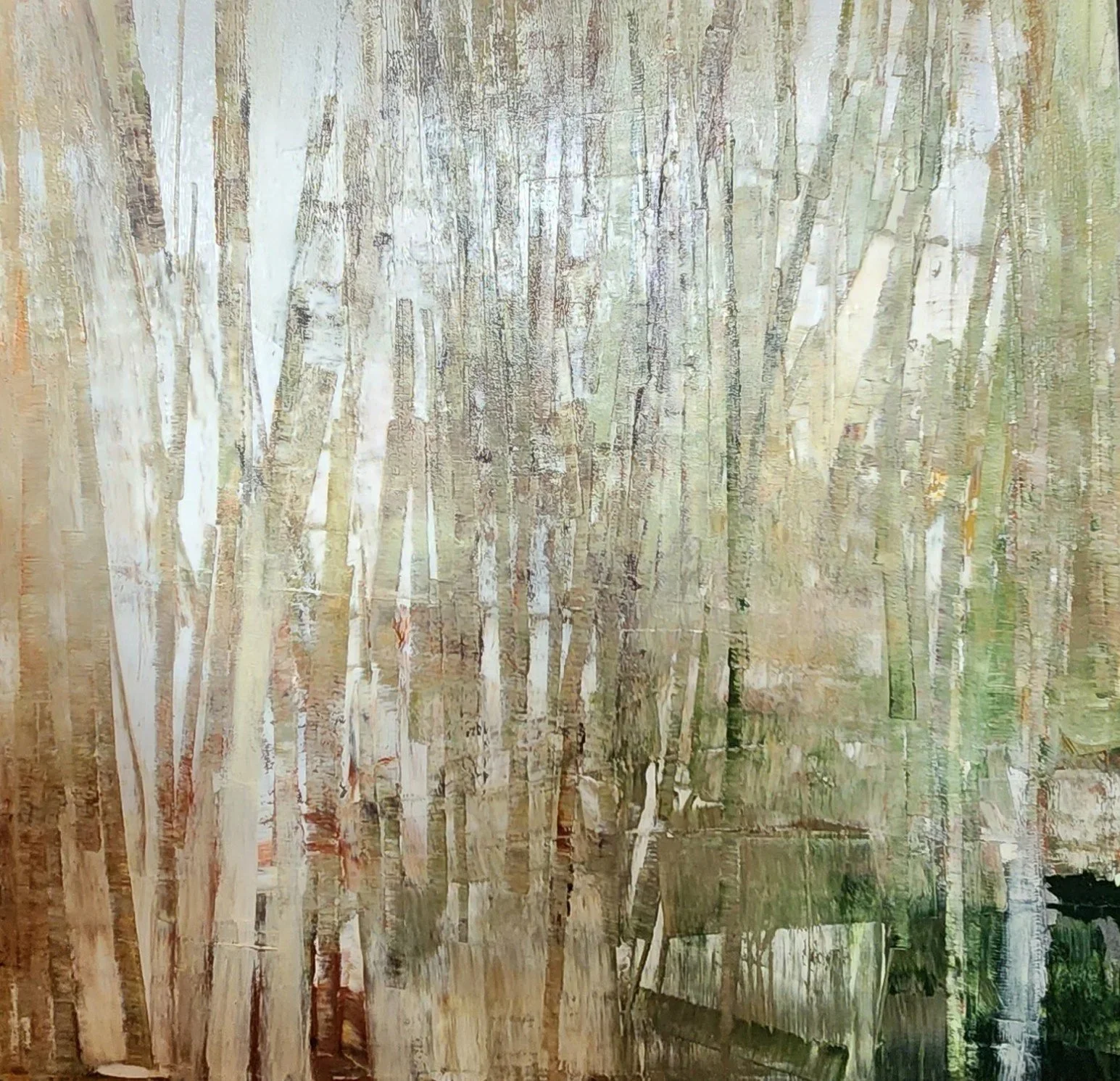
“Grasses”: Jenny Wilson, acrylic on canvas
Last July I attended a concert at the Yellow Barn Studio and Gallery featuring Jenny Wilson—a jazz musician and abstract painter living in Chevy Chase, Maryland. I’d had a complicated summer navigating matters of work, home, and heart, and was looking for a little respite.
It was a warm day, not too hot—surprising for July in the Mid-Atlantic. Arriving late, I settled into a back row seat with a full view of Jenny on the keyboard and her fellow musicians on bass and percussion. Jenny’s abstract paintings hung on all four walls of the gallery. Across the room an open window offered a gentle breeze and a partial view of distant, swaying trees.
It didn’t take long (one song, in fact) for all of these elements—music and art, leaves and branches—to converge into one continuous ribbon of sound, sight, and texture. For an hour, I let go of my churning mind, always grasping and defining, and allowed Jenny’s jazz notes and imaginative paintings to work their magic. Afterward, I sought Jenny out to thank her for the concert, and to share how I thought her music “sounded like her paintings” and vice-verse—an awkward attempt to describe the ineffable.
I’m hardly the first to fall under the spell of a hybrid music and art experience. The Abstract Expressionists of the 1950s understood the potent pairing of bold lines and planes of color with a mellow keyboard, deep bass, and brushed cymbals soft as dove wings. On the way home from the concert, I reflected on the ways different art forms complement, harmonize, and uplift one another: jazz and abstract expressionism, sculpture and landscape gardening, brush painting and tea ceremony, calligraphy and ballet (more on the latter, in another essay).
My thoughts extended to other pairings that contribute not just to creativity, but contentment and overall human flourishing. One friend of mine combines his love for river kayaking with nature photography. Another friend moves seamlessly among fiction, theater, and songwriting about mythology and feminine identity. And yet another hosts an enduring podcast that marries his humor and knack for storytelling with his interest in climate science. When we approach our interests and passions with a wide-angle lens, it expands our universe.
Human flourishing, what the ancient Greeks called eudaimonia, is what transpires when the pursuit of excellence is aligned with a higher or common good. I’ve written about eudaimonia before. I believe in its noble ideal and love the syllabic sound of the word … eu-dai-mo-nia. It calls to mind a rolling river, the momentum of complementary currents. Aristotle considered eudaimonia one of the building blocks of a healthy, civic society.
This particular orientation is not quick to take hold. In younger years, we tend to organize our lives in singular tracks: career, marriage, family, friends. It can take a while to identify and take seriously other interests and drivers, let alone try to thread a needle between them. For the longest time, my enthusiasm for creative writing, painting, botanicals, and philosophy felt disparate and disjointed. Only recently have I begun to see just how well these things complement and enhance one another. When I dwell in one arena, it opens a portal to another arena.
For example: the principles of both East Asian brushpainting and Ikebana (the art of Japanese flower arrangement) draw upon the Taoist philosophy of ying-yang—the interdependent balance between darkness and light, passive and active, female and male. These attributes, the very same that produce harmonious paintings and floral arrangements, also play an integral role in equanimous thinking and living. Especially so in dark, tumultuous times.
I met up with Jenny again last autumn, when I visited her home studio to buy one of the paintings from her summer show. She called it, quite simply, ‘Grasses,’ although the title belies the rather complex idea of an insect’s eye-view staring up into long, green-gray blades of wild plants. ‘Grasses’ hangs in my dining room, where it reminds me of the Abundance that’s created when we combine things we love — art forms, experiences, people, ideas — when sound, sight, and texture complement one another. An insect’s version of jazz and art on summer day.